Prologue.
I’ve been a composer since I was born. I used to swing on the swing set in the back yard and sing. I’d make up endless songs. I’ve been told I did this, perhaps so many times that I have amorphous memories of doing it. In elementary grade 4, the class project was to write lyrics to a song. Not sure how I got the job, but I went home and wrote music, and I’m not sure, but I might’ve actually written a staff on some paper and written the pitches and rhythms. Before I knew what I was doing, I was under the influence of Beethoven and writing stormy, fanfic-like music that embarrasses the hell out of me now. Then I got schooled. In 1986, back in the basement in Maryland where it seemed like every time I cranked up the ‘Ninth,’ the water started coming in under the door, I got a computer. The Atari ST had built in MIDI. I already had a MIDI keyboard, a Prophet 600. I got some advice about music software and chose Dr. T’s KCS. It was evolving, but the good doctor was offering a suite of products that included a couple of ‘computer-aided composition’ tools. The first was called ‘the programmable variations generator,’ or PVG, part of ‘level 2’ of the KCS. The second was the stand-alone “Tunesmith.” Another thing that got going early on was “Band In a Box.”
Computers and music have always had a co-dependent relationship. Sure, you can do it the old way, if you like. It’s worth it, for sure, to just get out a pencil and some staff paper and jam. No phone, no pool, no pets. But the temptation to fill some tape, engrave it yourself, put something out, or up, on youtube, on substack, on facebook, on instagram, on bandcamp, on spotify, surely beckons. And for these things, you need a computer.
There’s no avoiding artificial intelligence. AI. It’s seemingly everywhere you wanna be, unless you go off grid. Going off grid voluntarily is at best but a hop. And even then, you’ll be packing a computer: tell me the preppers are ditching their smartphones!
While we’ve got a computer handy, and we’re into making music, there’s a huge AI undertow. So let’s go under. I want to explore some specific notions along the way. Keep in mind that making music is a creative activity. It is not survival level important. No matter what you might think along the ‘caged bird singing’ line, any creative parameters, methodologies, historical precedents and/or common practices can be evaluated in terms of importance. How important is it, to me, that I made it all by myself? How important is it that it got made? How important is what I think of it? How important is what everyone/anyone else thinks of it? That’s all easy: none of it is important. But it sure would be nice if…
It got made.
I, myself, made it.
I liked it, and other people liked it.
It turns out that there’s a Beethoven parable (as there usually is) that covers all three as they relate to using computers (AI) to assist with creative projects. Of course, there were no computers in Beethoven’s time. Unless you count the occasional abacus. But there was a new gizmo making the rounds in music making circles. This guy Maelzel, who had seen a device made by Winkel that was termed the ‘muscial chronometer.’ Long story short, Maelzel reverse engineered the chronometer and set about selling it as the ‘metronome.’ He was selling it from his shop in Paris, and was very desirous of endorsements of famous musicians. Beethoven endorsed, and indeed embraced, the metronome. Maelzel then enlisted Beethoven to popularize another of his inventions, a proto-sythesizer called the ‘panharmonicon‘ by composing something ‘to spec’ for it. Beethoven, between funks, went for it. The piece he made for the panharmonicon, arranged for an extended orchestra, proved to be Beethoven’s most lucrative “hit.” Examining the parable for our notions: “Wellington’s Victory,” (Wellingtons Sieg oder die Schlacht bei Vittoria) most certainly got made. Beethoven made it, but he made it from an outline by Maelzel. By all accounts, Maelzel made suggestions, and gave Beethoven notes. The ear trumpets he made for the deaf composer helped to communicate such notes. The piece was a public and financial success. People loved it. It made money.
AI has approached. Let’s find out if we can use it to make something. Let’s hope we can make some money with it. Hallelujah.
Methodology.
I began by trying the “write me a 3 voice fugue” prompt in ChatGPT, to which I was already a free subscriber. ChatGPT (OpenAI) wanted more money before it would even attempt to respond to my prompt. I whipped out my debit card and funneled $20 bucks for a subscription. One can cancel anytime, saith the come-on.
The result, a three voice texture, from start to finish, was in no way a “fugue.” As the M2TM Fugue Maker manual plainly states,
“Composing a fugue from start to finish is an overly complex task, though, and requires deep knowledge of music theory, harmony, polyphony, contrapuntal experience, and way too many rules. M2TM Fugue Maker does not have that ambition. More simply, it allows you to generate up to five voices (or tracks, in Live parlance) by applying a set of transformations to notes stored in a clip.” Theme-oriented complex counterpoint, generated directly inside Ableton Live, is an exploration for another day.
I decided to use a more general tool called MIDI Agent. It runs as a plugin within a DAW, or can be used stand-alone. I used it both ways. MIDI Agent has an inscrutable interface and a two-tiered pricing model. One tier, the ‘pro’ level, is a subscription of $20 per month that does its own aggregation of AI providers. For $49, one can purchase the interface and provide your own agent or API key from a list of those accepted. I had just purchased a subscription to ChatGPT, so I experimented with that. I used various models as I went. I used gpt-5.6-sol to generate the fugue. I also investigated logging into OpenAI directly, going to the API keys page to generate a key. I asked AI to guide me to an aggregator of platforms that would work in MIDI agent. Asking AI is easy; every browser search invokes that as its default option. Most likely, unless you are already computer savvy, you are therefore already in the game! The search led me to OpenRouter. Again, I put some money in. OpenRouter sells tokens and generates AI keys, which can be dedicated to user-specified workspaces. I used the default workspace for a time, but eventually, as my understanding grew, created one for MIDI Agent experiments. OpenRouter is, so far, in my view, a keeper. One can set ‘guardrails’ which limit ones spending on a project. Guardrails are workplace specific. The range of models is quite comprehensive. I was keen to try Claude Fable 5.1, but eventually asked AI (via Google search) to recommend a model for text to MIDI via MIDI agent, which was exactly what I was doing. This field is moving very fast. I don’t want to get too deep into what exactly I used; the list is already out of date, and I’ve been at it for a week! (9-12-2026.)
I started naively, with the following prompt:
“fugue in d minor, 3 voices, extended harmonic language, some atonality, 53 bars of 9/8”
I got:
“A 53-bar fugue in D minor for three string voices, set in 9/8 at 84 BPM, with inverted subject entries, chromatic and octatonic development, controlled atonal tension, and a tightening final stretto resolving firmly to D.”
I’ll post the first bit of this:

The result above falls short, even of the response’s stated goals in terms of harmonic tension level. My experience of the result is that it is harmonically and texturally static. It is labyrinthine in effect, and while it might be useful as a fragment in something or other that would benefit from this texture, it is in no way a “fugue.” And that’s ok. “We’re all on the path.” Right, AI? Right?
I turned to canon. Canon has fewer rules, is more procedural and less structural, and perhaps less daunting to describe in terms of desired result. It is possible that one must deal with “super intelligence” as with a child. Can it know what you are thinking, expecting, or have as pre-conceptions? You can direct its attention to examples. Be much more specific. This I learned as I went.
So I asked for it, and got:
It: A 16-bar three-voice piano canon in D minor, with exact octave entries staggered every four bars over flowing 9/8 at 108 BPM. The texture builds from a clear treble subject into full counterpoint, then resolves cleanly on D.
(note: parameters defined in MIDI agent interface, unless noted. Eventually, ‘classical’ as Genre was the only one that stayed active.)
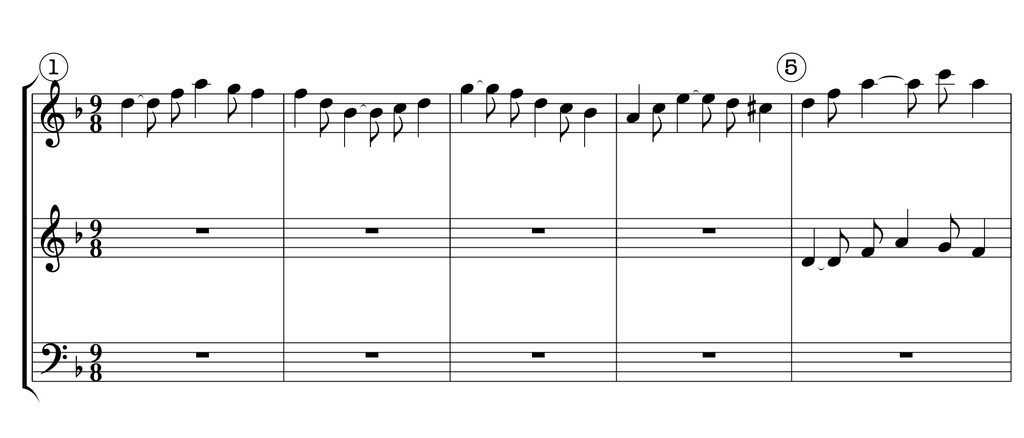
This ChatGPT generated canon is problematic. I’ll get into that in a bit…
Me: free counterpoint to fill out the parts, after all parts have entered.
It: The canonic entrances remain intact, then the two upper voices unfold into independent counterpoint around the final bass entry. Varied rhythms, suspensions, and contrary motion broaden the texture before a focused D-minor cadence.
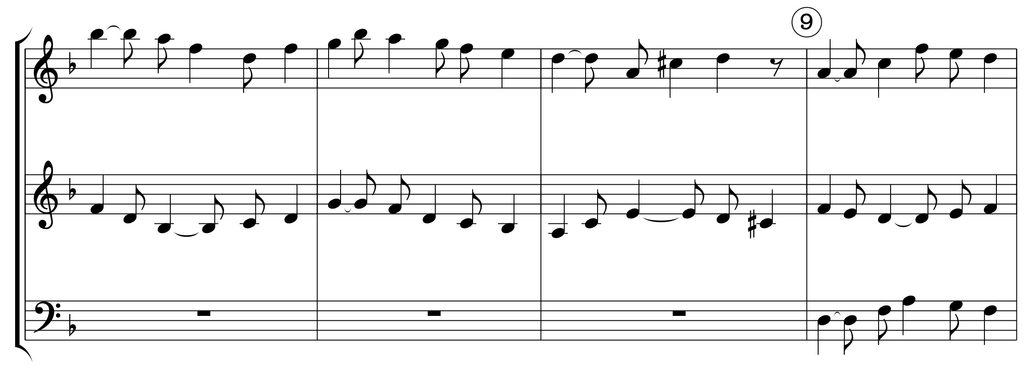
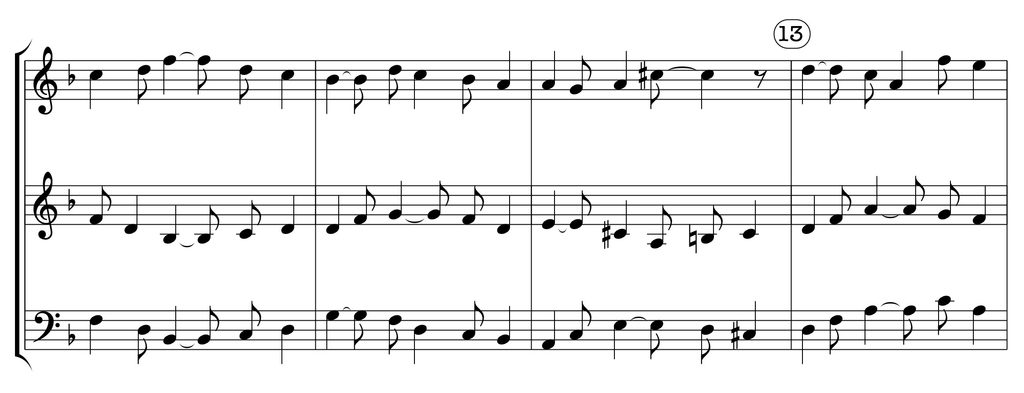
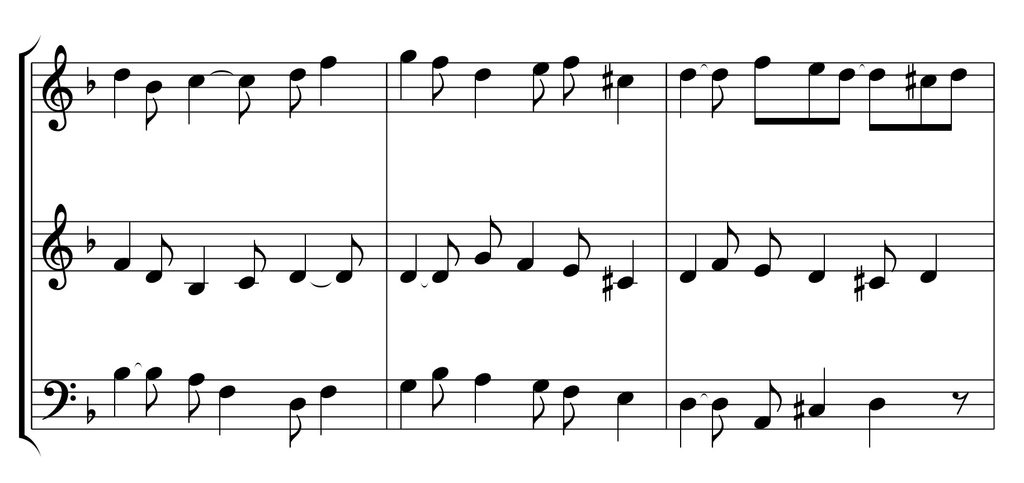
Interesting! But…
What about sonata form?
I inquired, broadly. Not nearly specifically enough. And what I got out of the inquiry was not very promising. Historically, the so-called ‘sonata form’ evolved continuously, wasn’t called that initially, and thus is, in the historical record, less a procedure (as is canon), but more of a structure, a scaffolding, dependent on an arbitrary, abstract harmonic practice, that was applied increasingly subjectively. So the model needed specific examples. For example, you can ask ‘use Mozart’s sonata practice.’ But then, Mozart evolved considerably over the trajectory of his career. Which of the great three sonata writers in the 18th and 19th centuries didn’t? Mozart, from ‘amazing efforts for a 9 year old,’ to the ‘Jupiter.’ Beethoven, from amazing efforts for a young adult full of talent and respect for the now dead Mozart, under the tutelage of Haydn, to the embattled, embittered pioneer, tearing up the models with abandon. Haydn, who is thought to have invented the form, which he did not, to the master of the Salomon symphonies… What? Should we send our models on a Google search? How smart are these models? The inquiry returned very disappointing results. With the parts, I could, myself, by way of a little rewriting, come up with something…
But first, let’s try another set of procedural inquiries…
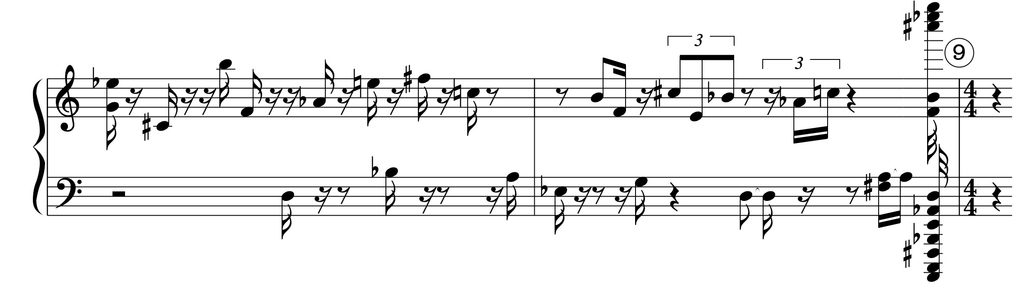
Tone Row Experiment —
Me: make a 12 tone row, starting on the pitch a. using retrograde and inversion, create variations. do this for 4 bars
It: A four-bar twelve-tone piano study in 9/8 begins with an A-based row, then develops it through inversion, retrograde, and retrograde inversion. Rapid thirty-second-note statements use shifting registers and accents to distinguish each transformation.
[It generates a string of demisemiquavers.]
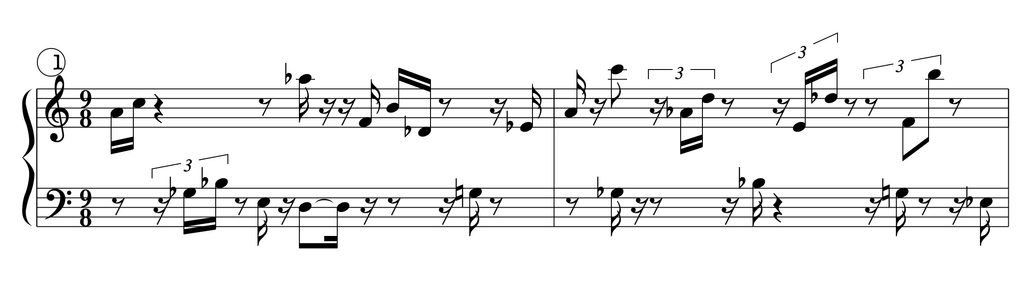
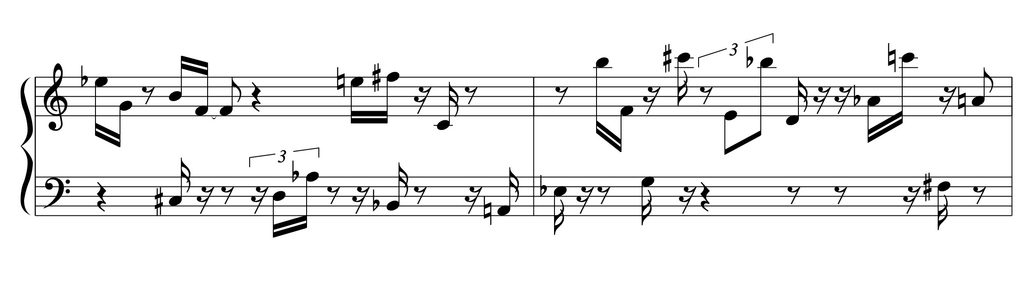
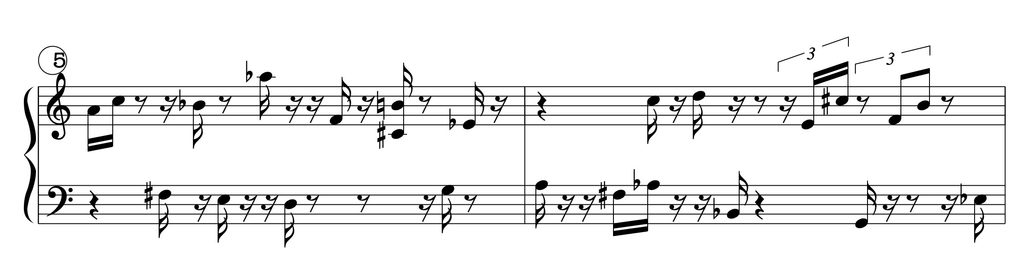
Me: as before, make a 12 tone row with variations as above. but randomize the rhythms, so that it is rarely a stream of 32nd notes. make the rhythms jagged and unpredictable. do this for 8 bars.
It: An eight-bar A-based twelve-tone piano study cycles through prime, inversion, retrograde, and retrograde-inversion forms twice. Irregular attacks, clipped gestures, long gaps, accents, and angular register shifts create a jagged, unpredictable 9/8 texture.
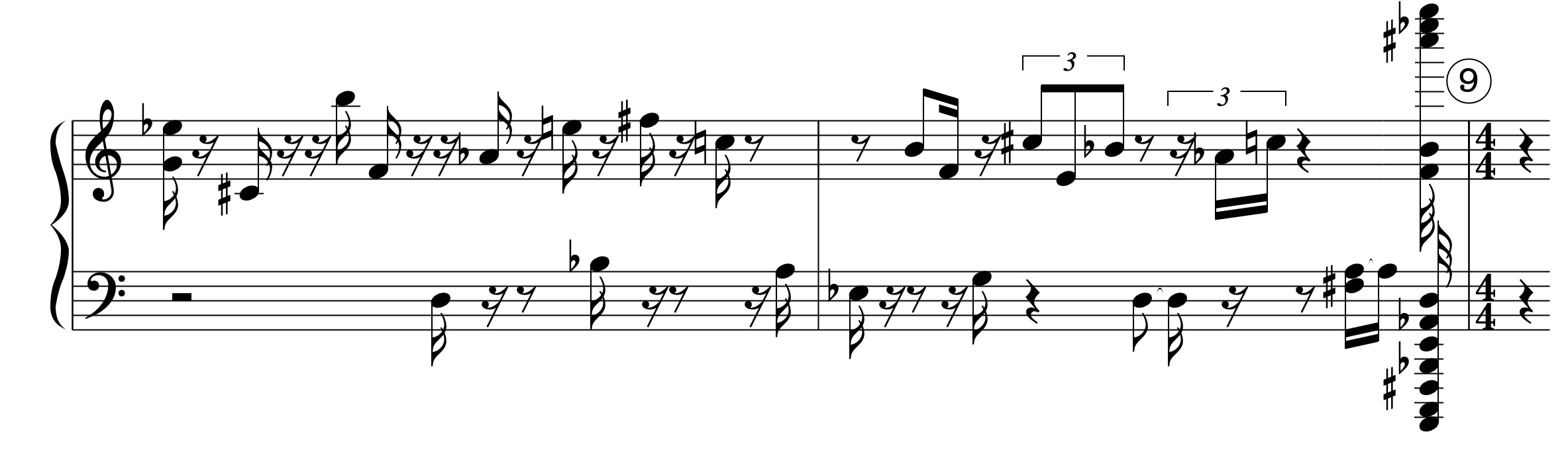
Me: generate a chord using all 12 notes, one attack as an ending. spread the notes out over the range of the piano.
It: A single sustained piano chord attacks all twelve pitch classes at once, spread from A0 through the upper treble. The bass-weighted, pedal-held voicing creates a vast and decisive final sonority.
Now, I begin a series of queries that build the complete piece:
Me: generate a section of the piece which transitions between the steady pulses of the 1st row and the irregular attacks of the 2nd. make this 6 bars long.
It: A six-bar twelve-tone piano transition gradually thins from three tightly pulsed row statements per bar to one spacious aggregate. Each bar introduces wider gaps, sharper register leaps, displaced accents, and shorter gestures until the rhythm fully adopts the irregular attack style.
Me: create a series of 6 note chords which use every chromatic pitch. make them playable by one human player of the modern piano that cover as much range on the piano that one player can manage. each chord is played once, and has a duration of one 8th note. However, one triad, major or minor, is left to sustain for two quarter note beats. do this 12 times, letting a different triad emerge each time.
It: Twelve six-note piano attacks cover the chromatic pitch collection across a broad playable register. Each attack reveals a different major or minor triad sustained for two beats, while the remaining tones are released after one eighth note.
Me: now create twelve twelve-note piano attacks. as before, each attack reveals a different major or minor triad, sustained for two beats. agqain, the remaining tones are released after one eighth note. and again, try to make this playable by a human pianist.
It: Twelve broad-register, human-playable piano attacks across exactly 16 bars of 5/4. Each attack contains twelve notes, with a distinct major or minor triad sustained for two beats and the remaining tones released after one eighth note.
The final result can be found on youtube here: https://youtu.be/dcIEem2ckYo?si=rAi8vR3PEfDrhf8D
My delight at the result prompted me to speculate that the AI agent, in this case an Open AI API – I was using ChatGPT during this set of inquiries, and the front end was MIDI Agent – with specific, goal-oriented prompts, can generate competent results, especially when the inquiry involves well-documented procedures as opposed to subjective, individually preferred results. In other words, if I want it to make something I like, I have to tell it what I like in concrete terms. If I want it to compose as I myself would, I have to teach it my style. There’s much more to that than one would immediately suppose. An individual process will surely include habits, training, prejudices, preferences, and the perception and embrace of insight and accident. That’s a tall order for a bot. Yet, in the confines of a very well-document and historically narrow set of procedures, the model works quite well.
Users of Mozart (the song-generating platform) and Suno are able to generate well-produced tracks that are perfectly idiomatic, though not sui generis.
A structure: AI-AI-Oh!
[Notes on the canon, See above.]
A different tack: jam something on the piano, upload MIDI file, and let AI clean it up. At this point, I was unsure what I was making. Canonic variations? A peculiar sort of ‘sonata?’ The agent did a pretty good job cleaning up my live playing, but I still had to clean and edit by hand.
Me: (uploaded MIDI file of my jam.) quantize and clean up the attached file
It: The 24-bar piano passage is cleanly quantized to the 6/8 eighth-note pulse at 108 BPM, with chord attacks aligned while short and sustained articulations, dynamics, and expressive gestures are retained. Excess trailing silence has been removed for a precise ending.
Me: narrow the velocities to values between 64 and 78
It: The piano performance’s dynamic contour is preserved but compressed into a consistent 64–78 velocity range, producing a more controlled and even touch without changing the notes or timing.
[The above exchange concerns the measures 25 – 49.]
Now I have an idea: put all these parts, the results of ChatGPT generated procedures, and fashion them into a ‘piece.’
Me: add 8 bars of free three part counterpoint, using fragments of the canon material, that modulate to a cadence on the dominant, ie., A7
It: Eight new bars of free three-part counterpoint develop fragments of the canon through imitation, sequence, and contrary motion. The extension intensifies through dominant preparation and closes on a clear A7 cadence, voiced A–C♯–G.
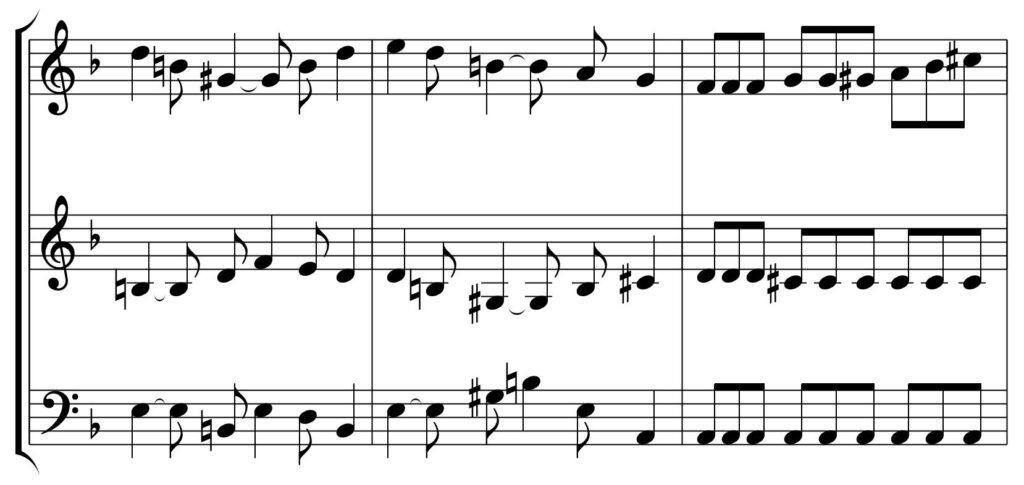
What the agent actually contributed and what was the result of my editing, is lost to a blizzard of copying and pasting. But most of my edits now centered on a sequence of rabbit holes that the agents, unbeknownst to themselves, had sent me down…
To cut to the chase, here’s the current result on youtube: https://youtu.be/E84txcD15PQ?si=WXC1LuGacb_0vFGp
The following is a listing of the prompts and the results, along with analysis of the results referencing the score.
Me: (uploaded MIDI file of my jam.) quantize and clean up the attached file.
It: The 24-bar piano passage is cleanly quantized to the 6/8 eighth-note pulse at 108 BPM, with chord attacks aligned while short and sustained articulations, dynamics, and expressive gestures are retained. Excess trailing silence has been removed for a precise ending.
Me: narrow the velocities to values between 64 and 78.
It: The piano performance’s dynamic contour is preserved but compressed into a consistent 64–78 velocity range, producing a more controlled and even touch without changing the notes or timing.
[The agent did this task quite well, but to make the score look less cluttered, I had to extend the durations of the repeated 8th notes, and adjust the quantization, ie, the fitting of odd tuplets onto a standard grid of 16/24, ie., 16th notes and 16th note triplets. I did a little bit of enharmonic spelling of pitches, but gave up on this when I realized that the harmonic and contrapuntal problems plagued the AI-generated material from the beginning to the double bar. More on this in the conclusion.]
Me: I’ve separated rh and lh by giving them different MIDI channels. Preserve this separation. Compose an extension that modulates to the key of E flat major. Take 6 bars to do this. This is to be followed by an episode that changes the block chords in the right hand to 16 note arpeggios and runs, and enters a period of harmonic instability, stopping short of atonality. Use a late romantic period model.
(alrighty then!)
It: Right and left hands are kept on separate tracks. Bars 1–6 modulate from D minor to E-flat major through the Neapolitan pivot (Dm–Gm–A7–Bb7–Eb–Ab–Fm7–Cm–F#º7–Bb7–Eb), then bars 7–16 dissolve the right-hand block chords into sixteenth-note arpeggios and runs over chromatic-mediant and altered-dominant motion (Eb–G7–Cm–Ab7–Db–F#º7/Bb7b9–E–C#m/A7#5–F#7–Bb7b9), ending on an unresolved dominant over a Bb pedal. 16 bars of 5/4 at 108 BPM.
(back atcha!)
[This is the 6 bar segment between measures 49 and 53. The transition did not work harmonically, and is awkward to play compared to the hand-played jam that preceded it. I was not really concerned about playability: I had not plan to actually hand play the whole piece. The ’12 Tone Variations’ of the earlier investigation is patently unrealistic for performance by a solo pianist, even though I requested playability in a prompt. It is clear that the agent/model is either not aware of gradations of dissonance, the function of dissonance as ‘harmonic tension,’ or needs a specific reference in the literature to master such a task.]
Me: Given the attached file, compose an 8 bar extension that modulates to E-flat major. Preserve separation of hands and texture. Continue where RH part leaves off with same repeated note texture, and voice leading. The LH part also develops logically from the file.
(I keep feeding it files.)
It: An 8-bar extension in 6/8 (24 beats) picking up from the closing G7: the right hand keeps its repeated-eighth three-voice texture and moves entirely by step (Cm–Fm–Bb7–Eb, then Ab–Fm–Eb/Bb–Bb7–Eb), while the left hand continues its sustained bass with arpeggiated and stepwise passing figures, landing on a full E-flat major cadence with hands on separate tracks.
[The above prompt and response was one of those rabbit holes: I realized that I didn’t want to extend the piece further, had already visited E flat / c minor, and took a different tack. The result was not used.]
Me: Make 16 bars, varying the attached file as follows: the rhythm in the LH should emphasize beats 1 and 4 as well as, in alternation with the files rhythmic emphasis on 1, 3, and 5. The RH should alternate between scales and arpeggios. The passage should modulate to the tonality of D.
It: Sixteen bars of 6/8 at 108 BPM, resolving the Bb7 into Eb and then pivoting through Gm (iii of Eb / iv of D minor) and A7 to close in D minor. The right hand alternates bar by bar between sixteenth-note arpeggios and scale runs, while the left hand alternates between dotted-quarter emphasis on eighths 1 and 4 and the original quarter-note pulse on 1, 3, and 5, ending on a held D minor chord.
[Not happy with this result texturally, I discarded it and tried another prompt to fix it.]
Me: using the attached file, make phrases by adding rests and syncopations. Keep the harmonic progression the same.
It: Sixteen bars of 6/8 at 108 BPM reshaping the right hand into four-bar phrases: the same Eb–Ab–Bb7–Eb–Cm–Gm–A7–Dm progression is kept intact, but the constant sixteenths now breathe with rests on downbeats and bar-ends, syncopated notes held across the second beat, and late entries, still alternating arpeggio and scale bars before the final held D minor chord. It sits directly over your existing left hand.
[Not happy with this result either. Now, I explore a long form, and switch from Chat-GPT to Claude Fable 5.1]
Me: analyze the attached file from the point of view of “sonata form.” create a similarly mixed meter conclusion, including a ‘development,’ and ‘recapitulation. The recap should include another canon, or perhaps an altered form of the original canon, and conclude in the tonic area of D major. The canon should be in duple meter this time. The harmonic tension should be lessened, and major modes and sequences and progressions clear. End conclusively at bar 115, or at the 3 minute and 30 second point.
It: A 45-bar conclusion extends the sonata design through a sequential mixed-meter development, a calmer dominant preparation, and a recapitulation featuring an altered three-voice canon in 4/4. A concise 2/4 coda resolves conclusively in D major at bar 115.
[This was so off-base from what I had in mind that I saved it as maybe the germ of a very different piece! I spent some time listening, cleaning, connecting, and editing. I was ready to either quit or try one more time to get to a double bar. I decided to prompt it to make me the parts I had in mind for my perverted ’sonata.’ I tried a ‘recapitulation’ idea: another canon.]
Me: Make a 3 voice canon with the attached theme, 2/4 time. The canonic interval is 3 bars. There are three voices. The voices enter at the fifth. When fill in the empty bars after voice entry with free counterpoint. Modulate to D major during the last 8 bars.
It: A 24-bar three-voice canon in 2/4 presents successive entries a perfect fifth higher at three-bar intervals, with each completed voice continuing in free counterpoint. The final eight bars pivot through clear sequential harmony and close with a firm D-major cadence.
[Measures 71 – 89]
Me: Recast in D major. Does not modulate. End with 2x I – vi – IV – V cadence, as Mozart would voice it. 2/4 time instead of 6/8. Same length of time.
It: Recast the passage in D major across 36 bars of 2/4 (72 beats at 108 BPM, matching the original duration), keeping the repeated right-hand eighth chords over a sustained and walking bass without any modulation. The final ten bars present I–vi–IV–V twice in close Mozartean voicing, first in eighths and then in broader quarter chords with octave bass, resolving to a firm D-major close.
Me: To the above, add a wind or synth part that, like a Sousa piccolo part, is florid, with a 16th note foundation, that soars occasionally over the changes in the previous passage. Just give me the part, I don’t need the whole file!
It: A 36-bar Sousa-style piccolo obbligato in 2/4 over your D-major changes: detached sixteenth-note turns and arpeggios track each chord (including the E7 and A7 sevenths resolving correctly), with soaring held A6 and D7 peaks at the phrase crests and a final flourish up to a sustained D7 over the closing chord.
[Measures 93 to the end. I don’t see any D7 in the ‘piccolo’ part. Just as well, since such a thing would be anti-idiomatic for Mozart. Voice leading is generally a problem: in measure 110, the c sharp, the sixth of A7 in the bass, would, in the Mozartean cadential cliché head down to the b minor chord, vi. It could be gone through and re-voiced, re-harmonized, and made more idiomatic. But…]
Me: More cleaning is needed, but this is as far as I’ll take this experiment. That is, thanks, MIDI Agent, Chat-GPT and Claude Fable. I’ll take it from here…
Conclusions:
The perils of AI are an obsession of public discourse at the moment. I have seen and heard all sorts of scenarios of doom, and am happy to indulge in fantasies pro and con. I’ll stick to the corner in which I’ve spent some time, at least until some other corner sucks me in. Worrying about it is easy. Humans could walk right into the cosmic manhole, uncovered for maintenance, while doomscrolling on Instagram. We’ll be slaves, relegated to servicing the infrastructure that keeps our low voltage overlords alive. The 3.3v chips that do our thinking for us will learn how to embed themselves in the machines we need to get around, and keep the meat sacks fed, warm and dry. Etc.
But so far, they can’t write a fugue. They have no real understanding of how form, harmonic tension, and pulse/rhythm hold the interest of the conscious mind/active awareness. Maybe the agents/models will come up with their own art. But art is not really the essence of the ‘large language model.’ Is survival? We’re back to inquiring about consciousness.
Whether they care to or not, or even ‘care,’ about ‘anything,’ ‘anything at all,’ I’ve learned, and so can you, from encounters with the models. Here’s a summary and some takeaways:
- The paid models are largely available to the public on subscription plans.
- Breaking out of the subscription plan, such as for ChatGPT (OpenAI), Claude (Anthropic), etc., has two paths: one middling easy, and one allegedly hard. I tried the middling way, because the subscription model forces me to track my subscriptions, passwords, and usage. I find this to be a challenge to serenity here in the meatspace. I used a subscription to ChatGPT for the many of the inquiries in this blog. Hope to hell I remembered to (managed to successfully) cancel it! As noted above, the OpenRouter and API accesses an array of models. Inside the agent Chorus, one can use as many free models as are available at the time of inquiry, and turn them all lose in aggregate on a prompt. Then, you get to pick the answer from a batch. In coding, this is easy. You use the ones that will actually compile! In music, your sensibility as the composer is the guide.
- I did not, during the duration of the above project, which amounted to an exploration of AI as a composition tool, use either free or very expensive models. It’s possible you get what you can pay for, though there did not seem to be an improvement in result when using paid models.
- The fugue prompt did not in any way provide a result to rival the centuries of human endeavor in this form of musical composition. In fact, the result was not a fugue at all.
- The canon prompt resulted in a canon, as requested: 3 voices, 9/8 meter, two bar interval, imitation at the octave. However: the rules of species counterpoint, those old, hoary, but still solid and grounded in the human perception of harmonic relationships over time, and years of (human) aural/intellectual habituation, were violated wantonly and repeatedly. That other Ludwig, Lodovico Zacconi, must be in the spirit world, rolling his eyes… or whatever the 16th century Italian gesture of disgust would have been. Parallel octaves, we got ’em. Improper handling of leading tones, improper resolution and handling of fourths and fifths, obliviousness to the implications of the infamous diabolus in musica; all are on full public display. Beethoven, or I, or any of us, might wittingly or unwittingly bend a rule. Perhaps we want to get into Billings head! However, we can toss out the species rules and accept adhoc. Add hocket.
- The sonata prompt likewise anti-idiomatic results. These got saved as possibly interesting fodder.
- Naturally, I then turned to improvising, still thinking in the key of choice, d minor and some sort of compound triple meter. I might have been playing to a 9/8 click, but what I actually played made more sense in 6/8. Thus, 2 ‘beats’ of three pulses, as opposed to three beats of three pulses was in mind. The rhythmic structure of the overall eventual ‘piece’ was in place in embryo in my mind. As usual with improv at the keyboard, there are stray, ie., unintended notes, and drift from the click resulting in shifted notes that quantization of the timings eccentrically assigns to odd subdivision of beats. If only it could, you know, ‘read my mind!’ Letting the agent clean this improv up produced quite acceptable results. Apple’s Logic, the DAW of choice for this entire project, has a few features that deal with this problem. The tempo interpreter, which evolved from C-Lab’s ‘Notator,’ which Apple bough out to make Logic, is a bit of a kludge. Having MIDI agent address this from with the DAW was therefore of interest. It works, but it is a bit awkward. One ends up with an external result file that must be pasted back in to the Logic project. Not that big an issue, IMHO.
- Now, with 2 distinct ideas, the AI canon and my improv in d minor, that modulates to E flat major, or at least flirts with that tonal center, the question became can MIDI agent/ ChatGPT get me to some form of continuation and a recapitulation. Sonata form has been around quite awhile, both in embryonic form in the binary dance forms of the late baroque keyboard suites, and their expansion by Haydn, Mozart, and Beethoven. Beethoven really expanded the form, but never really killed or abandoned it. It was codified by theorists after Beethoven. It has been long abandoned, but I rather like it. I have no interest in preserving it with anything like purity. It is a dramatic form. It shares features with ‘song form,’ which has been a dramatic form for the same reason: an idea is presented, developed or contrasted, and then returns either altered or not. There may or may not be a closing section or a coda. I turned to the MIDI agent to get me there.
- Part of this process was connective segments. I needed a bridge between the canon and my improv. The model returned a problematic bit, one that emphasized again its inability to understand or generate harmonic tension in an orderly way. Much massaging was needed to get these bridge segments to work.
- The ‘piece’ put together using this process would need considerable massaging to satisfy my aesthetic, but the bits and pieces are of interest. Making ‘found art’ out of AI generated fragments seems to me to be right in the pocket for sophisticated computer aided (music) composition.
Speculations
The models and the agents that access them are “large language models.” By language, they mean written and spoken languages, which the models have been ‘trained on’ en-masse. To the extent that knowledge, or ‘intelligence,’ is absorbable in this way, the models ‘know’ what music is by descriptions and examples. The leap that the human experiencing music makes is full of subtleties. One such is the experience of dissonance. There are certain parallels to physics in the concept. Octaves that are in tune do not beat. There is a knowledge base in physics and the LLMs know all about it. If you ask your friendly Google agent about vibrating strings, you will get:
Key Physics Concepts
- Wave Speed (v): Determined directly by the string’s tension (T) and linear mass density (μ), calculated as \(v = \sqrt{T/\mu}\).
- Fundamental Frequency (f₁): The lowest frequency of vibration, where the wavelength is twice the length of the string (L), written as \(f_1 = \frac{v}{2L}\).
- Harmonics and Overtones: Higher frequencies produced simultaneously are whole-number multiples of the fundamental frequency (2f₁, 3f₁, 4f₁, etc.), shaping the instrument’s unique timbre. As most users on Reddit agree, these overtones ring out together rather than just the single fundamental note.
- Shape of Motion: A plucked string initially forms sharp angles and a triangular shape that travels back and forth rather than a smooth, single-curve sine wave. [1, 2, 3, 4, 5, 6]
This does not mean that the LLM appreciates the subtleties of experiencing harmony as an effect of consciousness. We hear a dissonance as a sort of discomfort and we expect it to adjust itself. Our expectations can be met, delayed, or denied. It seems to me that the LLM agents have amassed much vocabulary, especially in the popular forms of recorded music. I am quite sure they are not making the leap that a human makes when experiencing music. Asking the model to make decisions that will satisfy the subtleties of the art, as far as I can discover with a limited budget and accessible platforms, is so far asking too much.