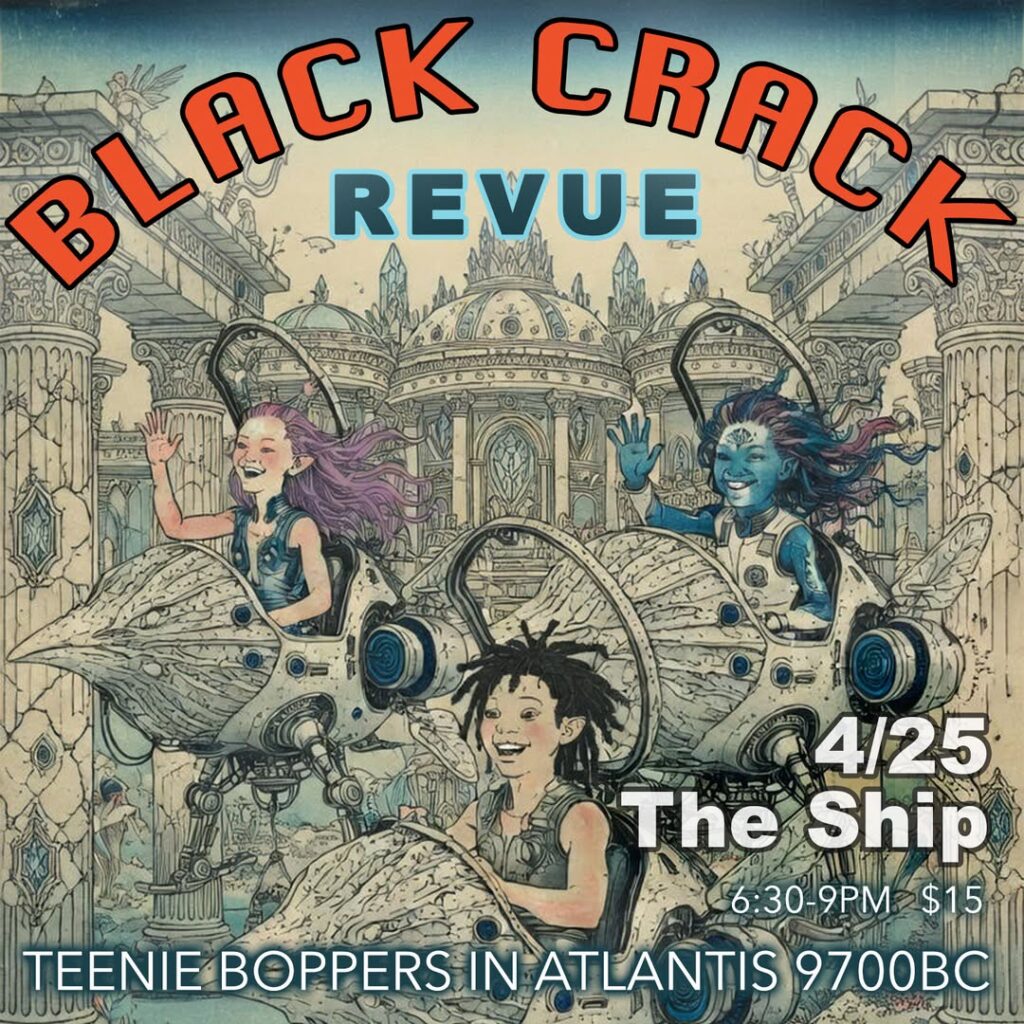
The BCR gig at The Ship. April 25, 2026.
I did not have time to take photos at the gig. I planned to arrive at The Ship at 5:15 PM, and the gig kicked off at 6:30. But some shots from the earlier, more relaxed (at least, for me), BCR appearance at The Ship in December will give the reader the idea:
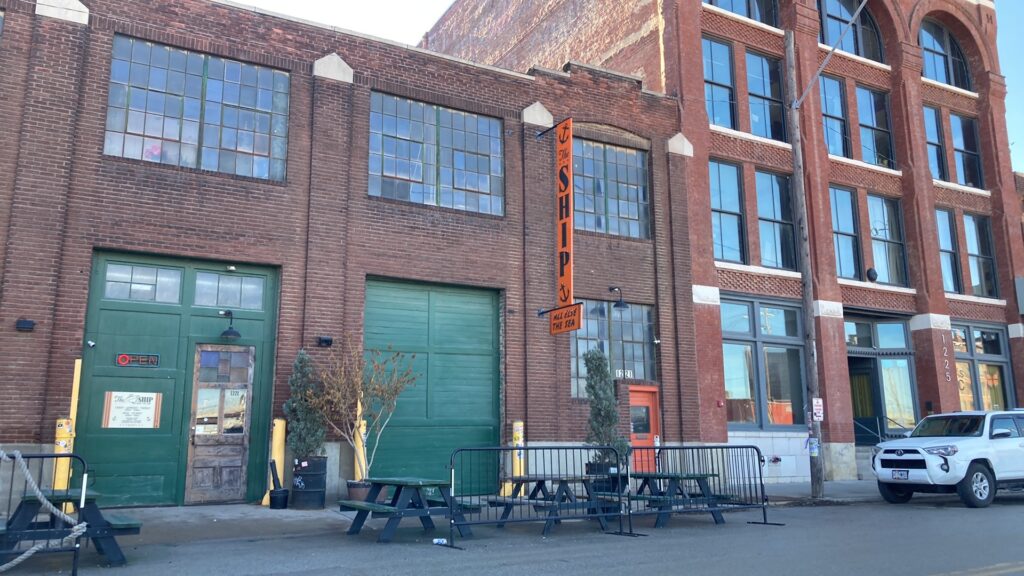
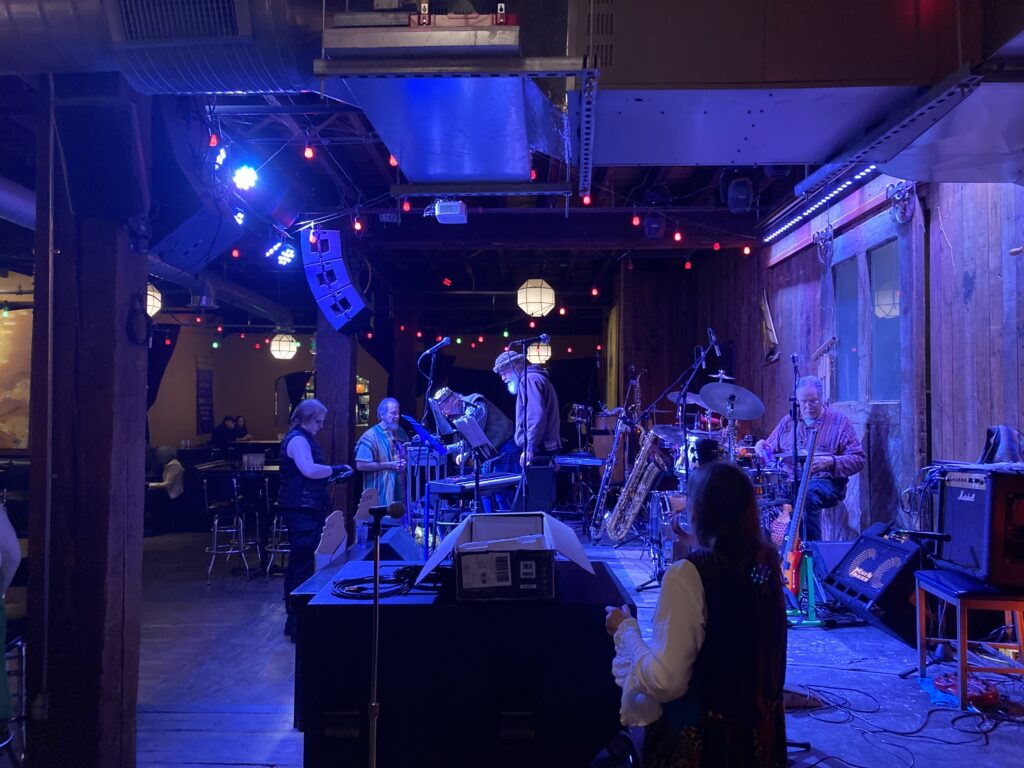
Here’s my account, both of the lead-up, and of the event.
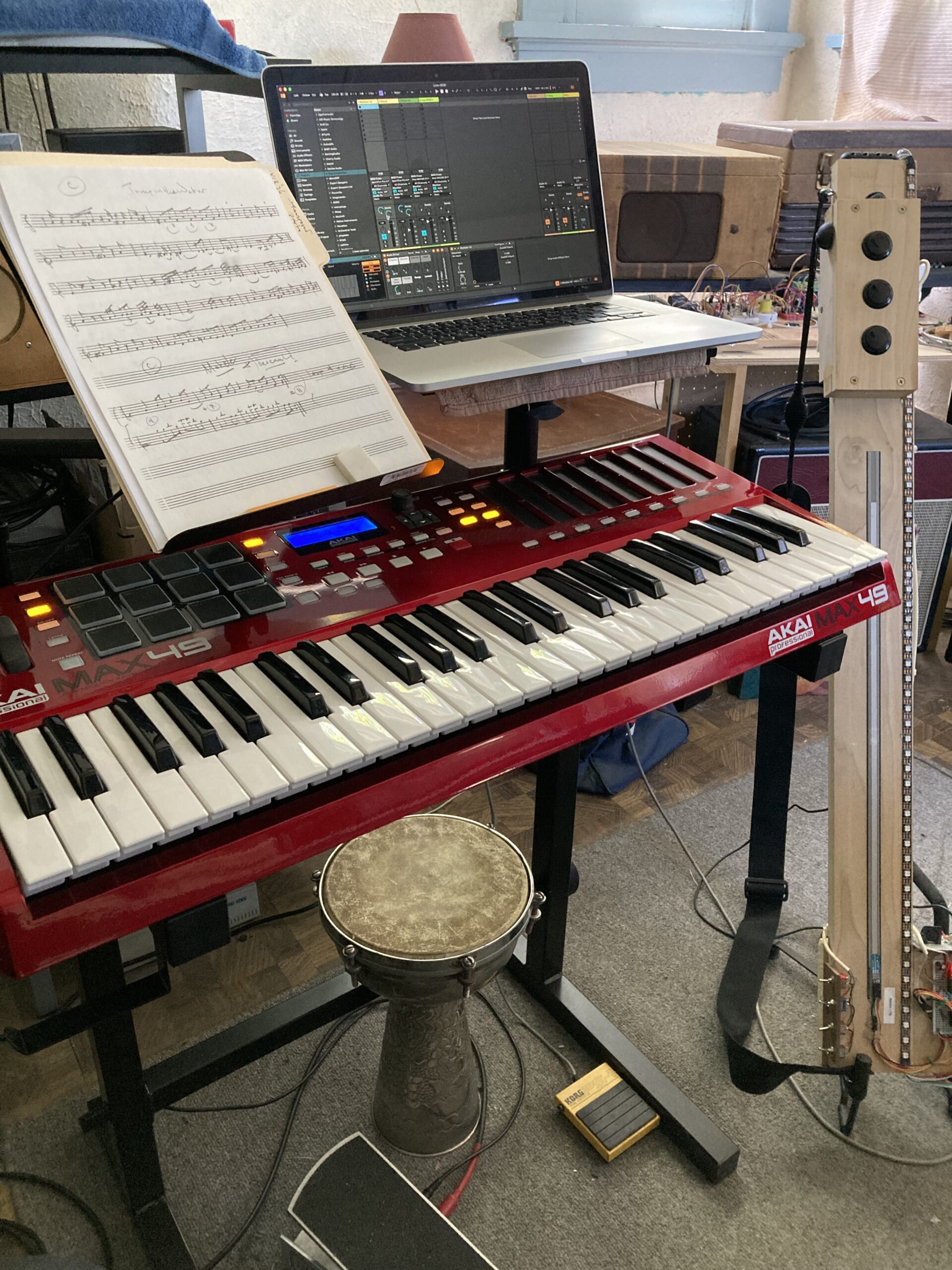
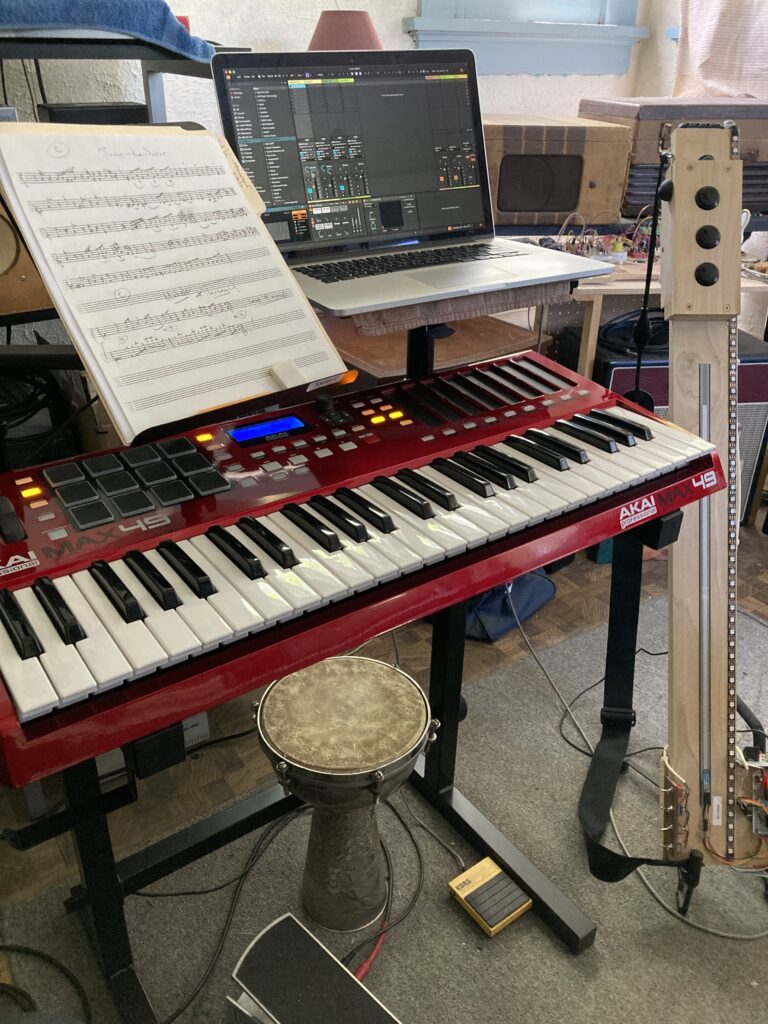
Dwight let me know ahead of time about the gig, and sent me charts and tracks. I used the charts and tracks to prepare. I transposed some of the charts from horn keys into concert pitch, and played along with the tracks, making notes. Here’s the rig I took:
In the photo of my rig below, taken in my second floor studio, you’ll note the part for “Jump In the Water.” I had transposed this in pencil, along with ‘Mokele,’ but the track was not in the key of A. It was in a solid, straight-up E flat. So I jotted down the changes and that was what I played at the gig. Also, I spent a bunch of time on a very funky part for Sun Ra’s “A Call for All Demons.” There were two tracks available, the plodding version that BCR had been doing back in the ’80s, and one that was an uptempo mambo, that is what the Arkestra played on a few of their recordings of ‘Demons.’ I recall that Dwight was a big fan of Ra when I met him, and that the fact the ‘Demons’ was, and is, the first chart in the Real Book (the fake book for jazzers everywhere), made it a natural for the fledgling ‘Crack to try. I was looking forward to ‘uptempo,’ but in the event, it was the downtempo version that happened. Ah well… either way, I got my licks in, and the prep was well worth it.
Set up was frantic. There was much chaos backstage, and load-in was complicated. I decided, therefore, to go with the stage monitors and not set up my Gallein Kruger 200MK keyboard amp. It was a good thing to save space on the stage, but I was more or less back in that familiar problem with the BCR from days of yore: I couldn’t hear what I was playing very well. In the break, I got the sound guy (whose name I missed) to bump me up in the monitors. That helped. BCR sound has come a long way since the ’80s, as one can imagine.
Behind me was Murshid Allaudin Ottinger on drum set. Dean was, is, and has always been rock solid and right in the pocket. He also does some singing, and in the processionals, plays his Nubian Tar. The tar referred to is the frame drum, not the Persian stringed instrument. Just FYI. I was in the front line, so most of the band was behind me: Allan Winkler played Animal-Hybrid percussion. Patrick Conway played percussion, vocals, alto sax. Mark Thies, on bass, also sang. The composer Julia Thro played a mean guitar throughout, and I have to say I became a great admirer of her composing, as I worked out her chart “Celestial Mammals” for the show. I could see behind and to my right Mr. Greg Mackender on vibraphone, another of the three guest artists on hand for the evening. (I was number three!) The rest of the front line, besides myself, was Samantha Weber, who sang a mean version of “Moliendo Cafe,” The estimable Thomas Aber on baritone sax, bass clarinet, and … ! … bagpipes! Tom was on the other side of Samantha. To my immediate right, so close that I was sometimes enveloped in his golden ephod, was the Reverend Dwight Frizzell, the founder of the feast. Dwight is playing a Yamaha WX5 wnd controller these days, along with his clarinet, and vocals. Dwight’s vocal performance includes a very SunRa-like form of emceeing, setting the scene for pieces with incantations and cosmic imprecations. Thus has it been for the past fifty years, my friends! And to my right… Kat Dison Nechlebová, in gold slacks, played … danced with… a great-sounding Moog Theremin.
I’d be remiss not to say a bit more about Kat. The theremin lends itself to movement, but in the usual way the instrument is employed, such movements involve the hands, and therefore, also the arms. There is usually not more action than that of the enthusiastic wind instrument performer, guitarist, or, for that matter, keyboardist. Kat takes the movement aspect of theremin performing to the next, if not an entirely different level. She full-on dances while playing, and her theremin responds with shrieks and cries well beyond the usual gamut of the instrument. I think the theremin had it coming. She’s part of all sorts of stuff, musical, artistic, and therapeutic, but to focus on music, she has just participated in a project with Joey Skidmore called “Nuclear Banana.” I’m still trying to figure out how to get ahold of this vinyl. If I do, I’ll post it!
The Black Crack Review appearance, at this point exactly one month ago, finally gave me a chance to perform with the Rhybbon I controller. I wrote about the creation of this device here. With Kat to my left, and Dwight to my right, standing up with the Rhybbon was visually and sonically appropriate. I had marked up the set list, and decided which tunes were most suitable. I was using Ableton Live 12, and created a channel strip with the following items: Arturia’s Modular 3, with the ‘Tech Police B’ patch called up, The ‘Scale Driver’ MIDI modifier, and a MIDI Monitor device. The monitor allowed me to see what pitch I was actually playing on the controller. The Rhybbon I, in MIDI mode, outputs note values with lowest being right side, and pitch ascends as one moves to the left on the ribbon. The force sensor, layered below the ribbon, is effective the the whole range, and beyond, as it extends past the length of the ribbon on the left side. The output is monophonic; only one MIDI note is sent at a time. The durations are limited by the serial transmission rate, which is the MIDI standard 31250 baud, but is limited when a pause on a single pitch occurs. Having visual output via a monitor is helpful in getting the hang of the controller. I put in enough time with it that I did not really need to refer to it much while performing. The scale driver is a way of limiting the notes that are sent to the sound maker (internal or external, but as noted, I had the internal modular chosen), and also will randomly choose from a set of pitch classes and/or intervals. In other words, it makes it very difficult to play a ‘wrong note.’ Choose the scale, choose the variability, and wail away! I mapped a few of the Rhybbon’s knobs to filter parameters on the patch (resonance and cutoff), and also had a second, selectable channel strip running a DX7-like instrument called DeXed. (Digital Suburban.) The patch I chose in DeXed is called ‘LAURIE.’ The two channel strips were selectable by programmed/mapped switches on the controller, so they could be used separately or combined. They sound about a whole tone apart, so using them coupled is useful for the most raucous moments. Finally, the three big arcade buttons on the Rhybbon I were mapped to drum sounds. I chose a trio of wooden mallet hits on a gigantic sounding slit drum.
Post-gig, we were loading out while the 2nd act was loading in. This was chaos choreographed. Sweaty, hasty work. This is what the Ship calls a ‘dinner matinee.’ Doable, bit for the bands, not ideal. I think the act following us was a DJ operation. They were pumping it out by the time I was loading the truck. I managed to back the truck into Allan Winkler’s car. Stupid of me! Shit happens, yeah. But I’ll be adding that to my list of travel expenses.
I had a great time playing with the band! I’m hoping to do it again at some point in the nearish future!