Susan Taylor arrives, we gather around a fire, there is a dance jam… But first…
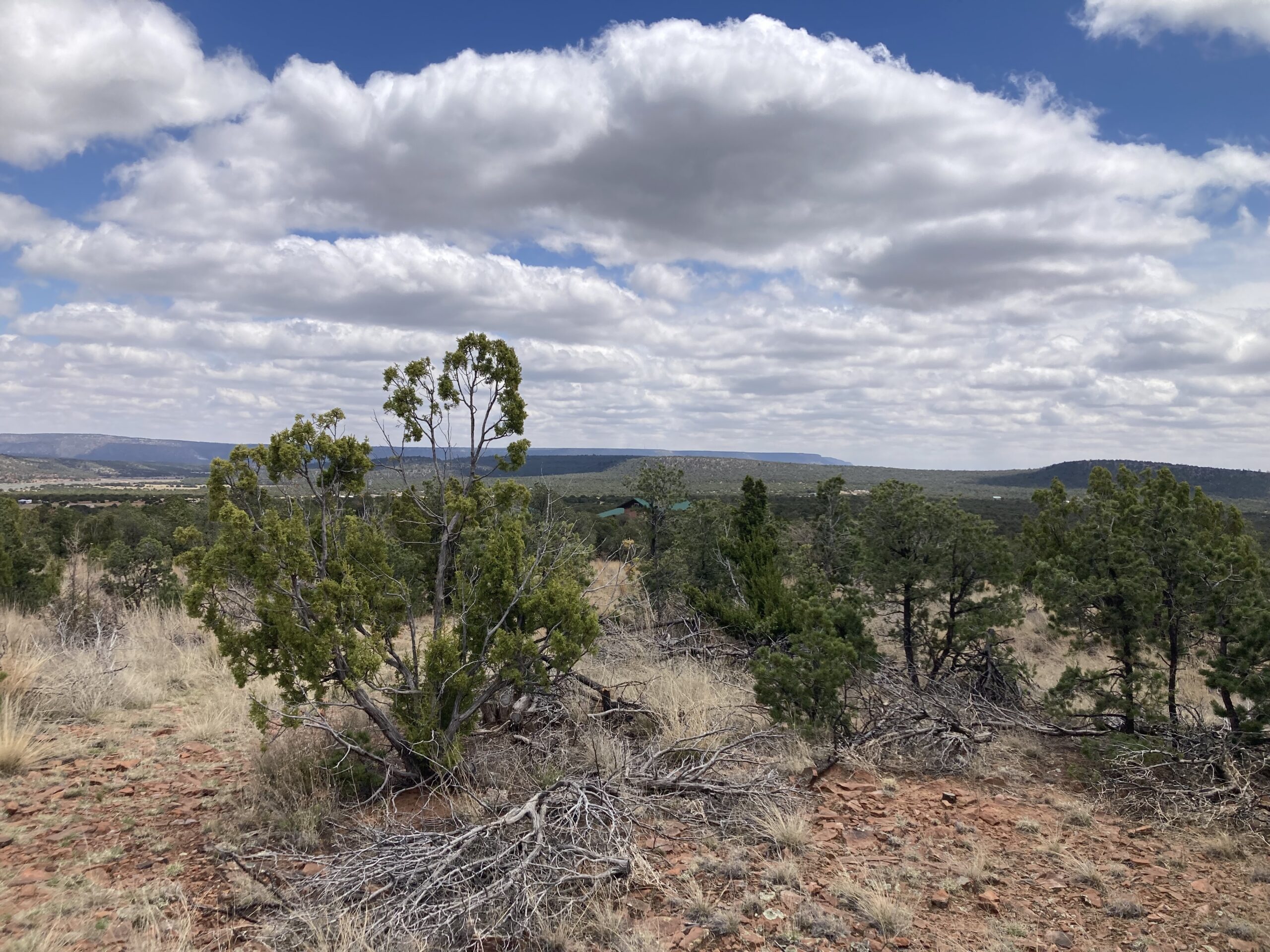
I had a morning, early afternoon to myself on the spread. I took advantage of the shower in the double-wide. I did some driving around. Had to scope out LasVegas for my trip home: gas, dump station, etc. Randy took me on a tour of Tecolote and LasVegas on the way to Tractor Supply for a trailer tire. (Didn’t want to risk driving home without a spare.) Took a hike in search of cellular bars. Snapped the photo below.
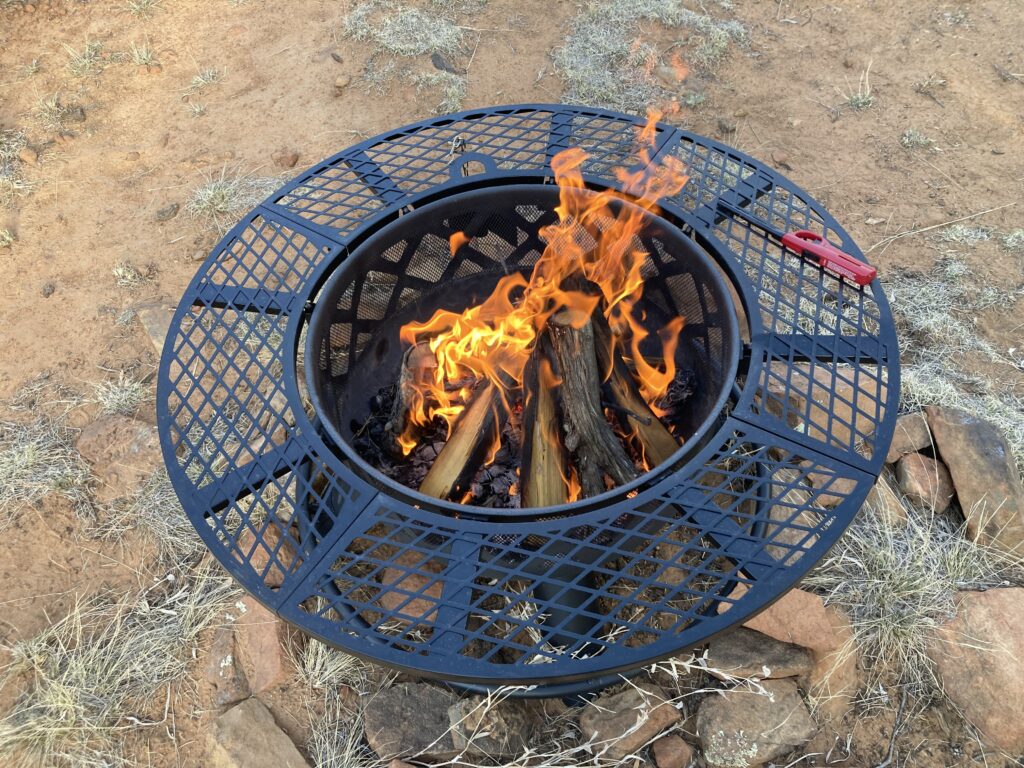
Meanwhile, Randy got some logs in his fire ring and got it lit. Operating separately, Kathleen went in to pick up Susan Taylor. I was meeting Susan for the first time, and all I knew was that she was a dancer and choreographer. What an odd sensation to meet someone “in the arts” without an internet investigation! That I registered that as an oddity is itself an oddity.
Susan came with groceries. Cooking began immediately. Susan is vegan. Though she shared her potage, she was sort of cooking for herself, I gathered. I love the relaxed atmosphere that has always prevailed around Randall J. Barron. He’s always been gregarious. It has taken me the better part of a lifetime to fully appreciate that as an advanced human feature. I have no idea how effortless it is, but is seems as natural as it gets. A large part of the comfort comes from the invitation to participate in activities which relieves the feeling of sitting around visiting. Of course, part of the equation is a willingness to participate. I had plenty of activities to choose from. Kathleen, Susan and Randy moved from task to task, and all the while there was conversation, books being brought of shelves, websites on laptops and tablets being read from and looked at and as a result, food was eaten, souls were also fed, and we came together in the evening around a fire.
Conversation around a fire is an ancient ritual, and has the potential for bonding. As energy waned, Susan rallied us with a song, and hands were held in a circle. She had mentioned a dance jam in the Casita in the morning. My gear was already set up out there, so I was in on that activity.
The women danced; Randy and I played available instruments. There were drums and various percussion instruments on hand. I took the opportunity to dig into some music-making software that I’d downloaded before I left for Kansas City.
Tessella is a Max for Live device by Philip Meyer that generates rhythmic MIDI information. It must be used in conjunction with a “kit,” ie., samples mapped to specific pitches in trigger mode. It is, therefore, a generator of information, with selectable parameters and attributes. Ableton Live is an old standard by now; its strong point, as the name suggests, is making loops on the fly. It can, however, be used as a platform for Max patches, so one can add almost anything imaginable to the mix. Obviously, it is all too easy to go sailing off into jargon and specialized lingo that only musicians who work with electronics and computers relate to. But here’s a word about Max: the software started out as ‘the Patcher,’ the brainchild of Miller Puckette at IRCAM. (Institut de Recherche et Coordination Acoustique/Musique.) By the 1990s, Puckette’s work had evolved into PureData (Pd), and was released in 1996. It was, and still is, open source. Cycling ’74 came out with a commercial version in 1997. Max/MSP is now up to version 9.1.4, as of April 7th, 2026. That’s the version I was packing on the road. Max is an object oriented language; instead of writing code, ‘patches’ are developed with various objects, each with inlets and outlets, each taking specific modifiers, and everything is connected with virtual patch cables. Max for Live (M4L) brings these patchers into Ableton Live for processing of various types: audio modifiers, processors, generators, and filters, and also MIDI generators, and processors, some quite extreme.
Vortessa, by Emiliano Pennisi, is a suite of patchers for Max MSP. The patchers are pre-assembled into a Max Project The ‘presentation mode’ view is quite nice and Mr. Pennisi was busily updating it during the time I was traveling. (I continue to explore his work, and am likely to write more about it soon!) Vortessa is a complex set of sound generation tools, and I had it running while I also ran Live, and interacted with Live on the Rhybbon. (I have developed a few Max patches for the Rhybbons, but they work perfectly well as controllers in anybody else’s software. In fact, my Max work needs some attention!)
So that’s what I was up to in the casita! The dancers were exploring various modes of improvisation, but most interestingly, they got into some intricate contact work not bound by anything other than gravity and imagination.
Since I had the Akai Max 49 there (a standard 49 key keyboard), I played also some of my old favorites; “Sí Bheag, Sí Mhór,” “A Child id Born,” “Star of the County Down,” various half-remembered jigs and waltzes… It is odd to note that pieces I’ve been playing in dance classes for 40 years have gotten to feel strange in my fingers, and my memory of them is faltering. Ah well… It might be time to let them go. I used them to death. Let me find new ones; I have new purposes to put my music to! (Perhaps.) It was interesting, to me, to observe the interaction between music and dance; it’s been a while since I’ve been in a studio. This wasn’t class, but rather, at least at first, more of a warmup that evolved into a contact jam. Contact, I’ve learned by observing it, takes much trust. Kathleen and Susan have been dancing for many years, and know each other well… but still, somatic trust, I would imagine, must to a certain extent, be reestablished per circumstance. The environment I presented was in the pocket for contact, but eventually I tired of it. I’m not sure if S and K tired of it at the same time. I remember that ancient Don Farnworth class in NYC where the accompanist switched from Schubert to some other thing. Farnworth called out, “you might be tired of it, but we’re not!” Somehow, I often thought of that in classes where my inclination was to try something else. Certainly, in a ballet context where, at the barre, working leg and standing leg alternate in successive “sides,” the same piece should be repeated! But when I pulled the plug on the environment, and began a survey of my half-remembered class rep, the response was interesting. The pair, now thoroughly warmed up, responded in various ways. Kathleen’s footwork in response to an improvised jig was fancy indeed!
In the end, we all seemed to have a good time with it. There was a proposed repeat of the activity, but by the time we got to it, I’d unloaded my gear from the casita, and I did a solo drum jam. Not nearly as versatile on my part, nor as confident.